
Why Chess Isn’t Hard: A Mindset Shift for Beginners
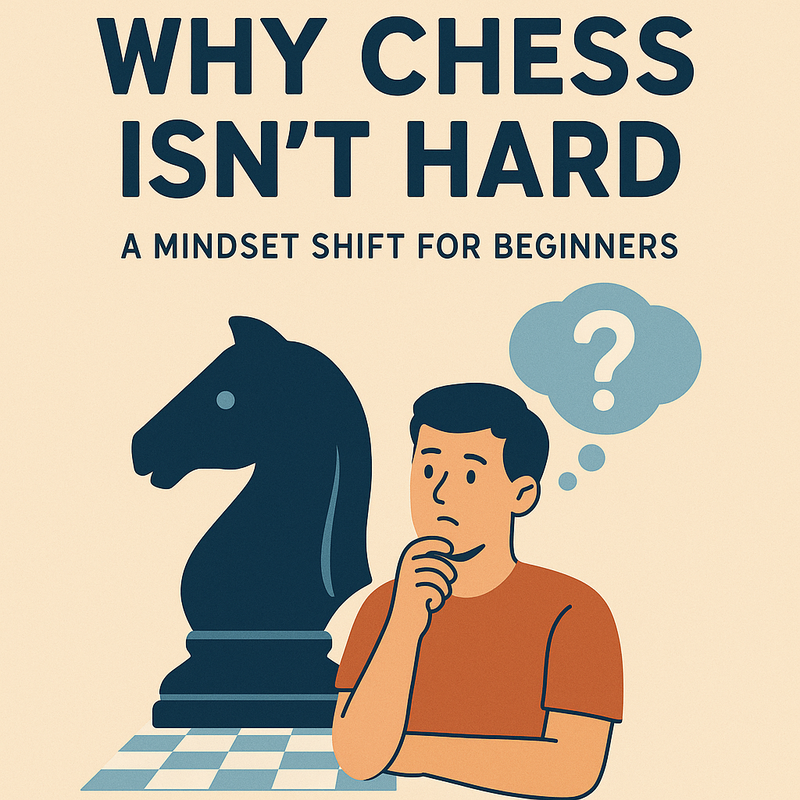
1. The Myth of Difficulty
The biggest barrier to learning chess is not the game itself but the belief that it's too hard. This belief often comes from:
- Watching elite tournaments with intense calculations
- Hearing phrases like "only geniuses play chess"
- The sheer number of books and videos that overwhelm beginners
In truth, chess is no harder than any other skill—like learning a musical instrument or a new language. The difference? Most people approach chess without a roadmap.
2. Simplicity at the Start
At its core, chess is just a board with 64 squares and 32 pieces. The basic rules can be taught in less than an hour. Here are just a few foundational truths:
- Each piece moves in a predictable, learnable way
- The goal is not to capture all pieces but to checkmate the king
- Many games are decided not by complex moves but by simple mistakes
This means that the earliest stages of chess are about recognizing basic patterns, not solving puzzles meant for grandmasters.
3. Patterns Over Memorization
One of the most effective ways to simplify chess is to focus on patterns, not memorization.
- A fork is a pattern
- A pin is a pattern
- A simple opening like "Develop knights before bishops" is a pattern
These are reusable ideas. Once recognized, they reduce thinking time and build confidence. Instead of memorizing 20 opening moves, beginners should learn why those moves are made.
4. Learning Chess Like a Language
Languages are not learned by memorizing a dictionary. They're learned by understanding structure, practicing regularly, and immersing yourself in the environment.
Chess is similar:
- The board is your sentence structure
- The pieces are your vocabulary
- The games you play are your conversations
Over time, you become fluent. And just like with language, mistakes are part of the process. Embrace them.
5. The Power of Guided Learning
Many beginners try to learn on their own. But just like a language coach or music teacher can accelerate learning, a good chess coach simplifies the journey.
- A coach filters what matters
- They tailor the learning pace
- They provide feedback, accountability, and encouragement
When you learn chess in a structured environment, with levels and feedback, the mountain becomes a staircase.
6. Shifting the Mindset: From Fear to Curiosity
Instead of asking: "Am I smart enough to play chess?" Ask: "Can I learn one small thing today about chess?"
That small shift in thinking can transform the entire experience. It’s no longer about being perfect or fast. It’s about being curious, consistent, and open to learning.
Final Thoughts
Chess is not hard. What’s hard is unlearning the myths we’ve been told about it.
By simplifying the journey, focusing on patterns, and adopting the right mindset, anyone—from a 6-year-old child to a 60-year-old beginner—can enjoy and improve at chess.
Chess isn’t a mountain. It’s a staircase. One step at a time.
About the Author:
Hi, I’m Jeganathan Selvasrinivasan — a FIDE-certified Lead Chess Instructor (LSI) and founder of IQ Trigger Academy, started in 2016. With a background as a Cloud Engineer, I teach chess to kids across the globe. My goal is to make chess simple through structured, level-based programs offered online and offline. I’ve helped thousands boost thinking and confidence. Call +1 (425) 440-8162 or visit iqtriggeracademy.com.
For Pro Classes, please fill the inquriy form: Pro Classes Inquiry Form
IQ Trigger Academy Contact WhatsApp
Our Facebook Page: Facebook
Our Instagram Page: Instragram
You may also like
 Jeganathan
Why Do Many Beginners Quit Chess Early?
Chess is a game of logic, creativity, and mental discipline. Yet, despite its countless benefits, ma… CM HGabor
How titled players lie to you
This post is a word of warning for the average club player. As the chess world is becoming increasin… OnTheQueenside
How many women have beaten super-GMs?
It's happened over 50 times! IM doughnut42
How Our Primate Brain Sabotages Winning Positions
Follow very closely as this could well be a reason you struggle to improve in chess. It's not about … ChessMonitor_Stats
Where do Grandmasters play Chess? - Lichess vs. Chess.com
This is the first large-scale analysis of Grandmaster activity across Chess.com and Lichess from 200… WFM fla2021